
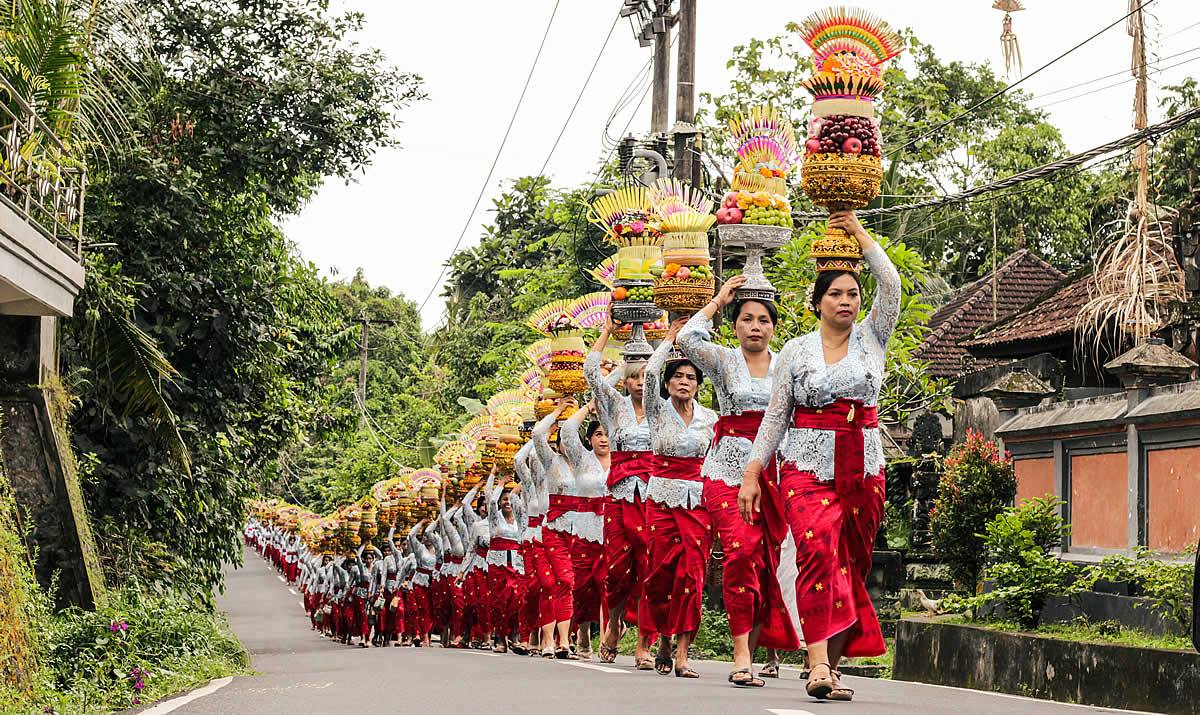
Women in traditional attire participate in a ceremonial procession in Gianyar, Bali, Indonesia | photo Gede Ary
Bali International › Women › Gender Gap Bali
Gender Gap Bali — A Low Score With a Complicated Story Underneath
Bali's Gender Inequality Index is 0.183 — less than half Indonesia's national score of 0.421, and one of the best of any province. Look at any single dimension underneath it, and the picture gets more complicated.
Women
Gender Gap Bali — A Composite Score That Hides as Much as It Shows
By the numbers, Bali looks like Indonesia’s gender-equality success story. Statistics Indonesia’s provincial office, BPS Bali, put the island’s Gender Inequality Index (Indeks Ketimpangan Gender, or IKG) at 0.183 in 2024, down from 0.239 in 2023 and 0.321 in 2022. Indonesia’s national score sits at 0.421. Only two of Bali’s own regencies, Gianyar and Tabanan, score even better than the provincial average. On the composite number, Bali is one of the most gender-equal places in the country.
BPS Bali’s own head of office, Agus Gede Hendrayana Hermawan, has been candid about what’s actually driving that number: the improvement is concentrated in reproductive health, women giving birth in health facilities and later in life, not in the dimensions that determine who holds power. In the same 2024 release, BPS Bali flagged that its own empowerment dimension (the education and legislative-representation gap between men and women) and its labor-market dimension (the gap in workforce participation) both widened compared to 2023, even as the headline score improved.
And Bali carries one gender-equality story that has nothing to do with any index at all: under Balinese Hindu customary law, a daughter is still, by default, not an heir.
This page follows the same structure as Gender Gap Indonesia: pay, power, safety, and education, each checked against the relevant UN target. Bali is a province, not a UN member state, so instead of the WEF’s Global Gender Gap Report, this page draws on BPS Bali’s own Gender Inequality Index, the Ministry of Women’s Empowerment and Child Protection (KemenPPPA), and local Bali-based organizations including LBH APIK Bali, the legal aid association that handles gender-based violence cases across the island. For the cultural and everyday-life context behind these numbers, visit Women in Bali.
Power — Inheritance, Family Status, and a Seat in the DPRD
The dimension that most distinguishes Bali from the rest of Indonesia isn’t political representation, though that gap is real too. It’s a customary inheritance system that predates any national law and still operates alongside it.
Under Balinese adat (customary) law, sons hold purusa status: they are heirs, they carry the family name forward, and they inherit the family’s ancestral property, including the household temple (sanggah). Daughters traditionally hold predana status, and under that status they are not heirs. A family with only daughters is, in the traditional framing researchers still hear in the field, treated as having no children at all, because a daughter cannot be counted on to continue the family line. The practical effect: women can be written out of their own family’s land, obligations, and communal standing purely on account of birth order and sex.
Bali does have paths around this, and they’ve genuinely evolved. A daughter can be granted sentana rajeg status, effectively reclassifying her as a son for inheritance purposes, usually when a family has no male children. In 2010, the Majelis Utama Desa Pakraman (MUDP) Bali, the island’s highest traditional-village authority, issued a decree recognizing daughters’ right to a partial inheritance share called gunakaya, typically half of what a son would receive. But researchers who study how this plays out in individual villages consistently find that the older kapurusa principle still governs in practice, encoded in each village’s own awig-awig (customary bylaws), and that a national decree from Denpasar doesn’t automatically override centuries of village-level custom. Legal scholars describe the current situation as a genuine duality: Indonesia’s 1945 Constitution and its CEDAW commitments guarantee gender equality on paper, while customary law, still very much a living legal system in Bali, keeps the purusa-predana distinction intact underneath it.
Formal political representation shows a smaller but related gap. Women hold 10 of the 55 seats (18.2%) in the Bali Provincial DPRD elected in 2024, below Indonesia’s national figure of 21.9% in the House of Representatives the same year, and well short of the 30% candidate quota that applies to every party list. BPS Bali’s own empowerment dimension singles out exactly this: the gap between men’s and women’s rates of at least a senior-high-school education, one of the index’s core inputs, widened in 2024 rather than narrowed.
Pay — A Tourism Economy Built on Informal, Female Labor
Bali’s economy runs overwhelmingly on tourism, and women are heavily represented in exactly the part of that economy with the least protection: informal work. Villa housekeeping, warung (small food-stall) ownership and staffing, market trading, and craft production are all sectors where Balinese women make up a large share of the workforce, largely outside formal contracts, minimum-wage enforcement, or social protection.
Nationally, researchers studying Bali alongside other provinces have found that women’s labor force participation responds strongly to specific, addressable levers, women’s average years of schooling, regional GDP per capita, and district minimum wage levels among them, rather than being fixed by culture alone. That matters for policy, because it means the gap BPS Bali flagged as widening in its 2024 empowerment and labor-market dimensions is a gap with identifiable levers, not an intractable one. Indonesia’s national gender pay gap (women earning roughly 23-30% less than men on comparable work) and the “double burden” documented by the ILO, where employed women also carry most household and childcare labor, both apply to Bali’s tourism workforce specifically, layered on top of a sector already defined by informality and seasonal insecurity.
Safety — Rising Reported Cases and a Legal Aid Gap
Reported violence against women in Bali rose sharply in the most recent full year on record. According to KemenPPPA data, cases increased from 330 in 2024 to 425 in 2025, a jump of nearly 100 cases in a single year. Denpasar recorded the highest raw count (147 cases), but the sharpest year-on-year increase was in Jembrana Regency, which went from just 1 recorded case in 2024 to 61 in 2025. Victims aged 25-44 make up the largest group, though 124 teenage girls aged 13-17 were also recorded as victims across the year. As with Indonesia’s national data, the most common location for violence is the home, and the most common perpetrator is a husband, partner, or family member, not a stranger.
Ni Luh Putu Anggreni, Secretary of LBH APIK Bali (the island’s Legal Aid Association for Women), has been direct about what the rising numbers reflect: gender-just law enforcement in Bali still has a long way to go, particularly for women who are poor, women with disabilities, and other vulnerable groups. She points specifically to a shortage of gender-sensitive law enforcement personnel, and calls for consistent education and outreach on the legal protections that already exist on paper, echoing the same gap BPS Bali’s own data shows between Bali’s strong composite score and the reality LBH APIK’s caseworkers see directly.
Education — Closing, Then Widening Again
Education is the dimension where Bali’s story is most genuinely two-sided. BPS Bali’s 2023 release credited improving legislative representation and a narrowing education gap as part of that year’s gains. The 2024 release reversed part of that finding: the gap between men’s and women’s rates of senior-high-school completion (age 25 and over) widened again, one of the two specific dimensions BPS Bali named as moving the wrong way even as the headline index improved.
That inconsistency is worth sitting with rather than resolving too quickly. A single year’s movement in one input to a composite index isn’t a reversal of decades of progress in girls’ schooling, but it is a reminder that Bali’s low, well-publicized IKG number can mask a dimension quietly moving backward underneath it, exactly the pattern BPS Bali’s own head of office and outside observers like LBH APIK are both pointing to.
RYB’s Place in This Picture
Neither RYB nor Bali International runs BPS Bali’s household surveys, KemenPPPA’s case data, or LBH APIK’s caseload. Statistics Indonesia’s Bali provincial office, the Ministry of Women’s Empowerment and Child Protection, and Bali-based legal aid and advocacy organizations do that work directly, often in Balinese and Indonesian, in courtrooms and villages the international conversation about Bali rarely reaches. What this page does is connect that work to the same framework used across RYB’s Global Development platform. The Gender Gap Indonesia page covers the national picture this page zooms in from; the SDGs Indonesia page tracks the country against all seventeen UN goals.
BPS-Statistics Indonesia, Bali Province
Gender Inequality Index (IKG) — Bali Province
2024
Score: 0.183 (down 0.056 from 2023)
› BPS Bali release
2023
Score: 0.239 (down 0.082 from 2022)
2022
Score: 0.321
Indonesia national (2024) for comparison
Score: 0.421 (down from 0.447 in 2023)
› BPS national release
Kementerian PPPA (Ministry of Women’s Empowerment and Child Protection)
Violence Against Women Case Data — Bali
2025: 425 cases (up from 330 in 2024)
› BaleBengong coverage
Sources and Links
- The Gender Inequality Index (IKG) of Bali Province 2024 — BPS-Statistics Indonesia, Bali Province | bali.bps.go.id
- Indeks Ketimpangan Gender (IKG) Provinsi Bali 2023 — BPS-Statistics Indonesia, Bali Province | bali.bps.go.id
- Indeks Ketimpangan Gender (IKG) Indonesia 2024 — BPS-Statistics Indonesia | bps.go.id
- Realitas di Balik Rendahnya Indeks Ketimpangan Gender Bali — IDN Times Bali (includes LBH APIK Bali comment) | bali.idntimes.com
- Kekerasan terhadap Perempuan di Bali Meningkat Sepanjang 2025 — BaleBengong | balebengong.id
- 55 Anggota DPRD Bali Masa Jabatan 2024-2029 Resmi Dilantik — Denpost (10 of 55 seats held by women) | denpost.id
- Reconstruct the Paradigm Shift of Inheritance Rights for Balinese Hindu Women — Russian Law Journal | russianlawjournal.org
- Inheritance in Balinese Customary Law: Dynamics and Its Linkage With Hindu Law — Jurnal Indonesia Sosial Teknologi, Vol 5 No 1 (2024) | researchgate.net
- The Dynamics of Women’s Position in Bali Customary Inheritance Law — Atlantis Press, ICBLT 2021 | atlantis-press.com
- Pengaruh Faktor Sosial Ekonomi terhadap TPAK Perempuan di Provinsi Bali dan Riau (2014-2024) — Universitas Gadjah Mada | etd.repository.ugm.ac.id
- Gender Gap Indonesia — RYB Global Development | redyellowblue.org/data/id/gender-gap/
- Bali International — About — bali.international/about/