
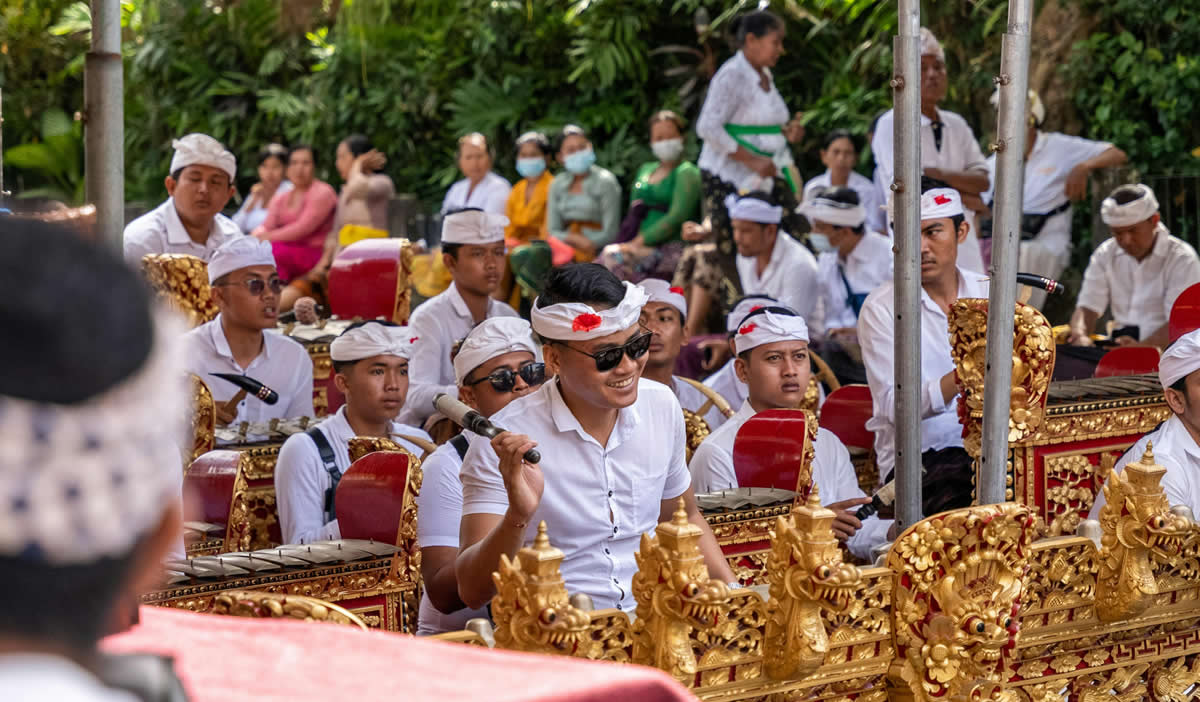
Traditional Balinese Gamelan Musicians Performing Outdoors. Photo by Pragyan Bezbaruah
Bali International › Arts & Culture › Gamelan Bali
Gamelan Bali (Balinese Gamelan) – Traditional Music of Bali
Arts & Culture
The Shimmering Soul of an Island
Before dawn in Ubud, before the roosters, you hear it: bronze voices, breathing gongs, metallophones cascading like a mountain waterfall. Twenty musicians sit cross-legged in a community pavilion, hands blurring across bronze keys. This is gamelan, and on this island it isn’t background music. It’s temple courtyards, village squares, cremation ceremonies. Gamelan doesn’t accompany Balinese life so much as it is Balinese life.
“Balinese Gamelan: Music, Dance, and Devotion” will feature BYU Professor Jeremy Grimshaw and visiting artists I Nyoman Windha and I Gusti Agung Ayu Warsiki. They will discuss the relationship between tradition and innovation in Balinese arts, including musical performances from members of Gamelan Bintang Wahyu, BYU’s Balinese percussion orchestra.
The Explosive Birth of Modern Kebyar
December 1915, Jagaraga village, North Bali: a gamelan competition that changed everything. When gong kebyar first exploded onto the scene, witnesses said tied cattle broke loose and ran. Kebyar means explosive, sudden, loud, and the name fit. Fast tempos, interlocking rhythms, sudden dynamic shifts, tight integration with dance, this wasn’t the gamelan anyone’s ancestors knew. Some scholars read it as quiet rebellion, a response to Dutch colonial rule in North Bali: when you can’t fight with weapons, you fight with sound. Within decades, over 1,500 active gamelan orchestras had spread across Bali, kebyar chief among them.
Older Forms, Older Voices
Kebyar is the youngest branch of a much older tree. Gamelan gender wayang, the smallest ensemble, needs only two players and underpins shadow-puppet theatre and the most sacred Hindu rituals. Gamelan semar pegulingan, dating to around the 17th century, is sweeter and more restrained, once played near palace sleeping chambers to lull royalty to sleep. Gamelan gambuh, the oldest of all, uses bamboo flutes and a seven-tone scale; its DNA still echoes through every modern piece. Balinese gamelan divides into three broad eras: gamelan tua (old forms like selonding and gender wayang), gamelan madya (middle-period forms like semar pegulingan), and gamelan anyar (20th-century creations like kebyar). Each serves different ceremonies, different spiritual needs.
Bronze, Tuning, and the Magic of Kotekan
A full ensemble can run twenty-five musicians or more. Gangsa metallophones, keys suspended over bamboo resonators, carry the melody; kendang drummers lead as conductors and spiritual guides, facing the dancers, breathing with every gesture; gongs mark the great cycles of time while smaller gong-chimes weave the melody between them. No standard pitch exists in Balinese music: each gamelan tunes to itself, and its instruments can’t simply be swapped with another ensemble’s. When a village commissions a new gamelan, it is born, tuned, and owned together, as a community.
The technique that makes it all shimmer is kotekan: two musicians interlocking parts, one playing the basic pattern (polos), the other the countermelody (sangsih), together forming a single rippling line neither could produce alone. It’s learned entirely by ear, no notation, over long apprenticeships, and it embodies something very Balinese: balance made audible, individual parts that only mean something in relationship to each other. This communal learning is called sekaha, voluntary collectives formed for a shared purpose, and the sekaha gong, the gamelan club, is one of Bali’s clearest expressions of community itself.
The Composers Who Shaped It
I Wayan Lotring (1887–1983) is considered one of the defining creative forces of 20th-century Balinese gamelan, shaping pelegongan, kebyar, gender wayang, and angklung alike. Trained in Sukawati, the historic heart of legong music, he composed pieces that bridged old and new, and his influence still runs through nearly every gamelan piece written since.
Wayan Lotring (1973 Kuta village, Bali)
A young Canadian composer, Colin McPhee, heard gamelan recordings in the 1930s and moved to Bali soon after, building a house near Sayan and immersing himself completely. His book Music in Bali remains foundational, and his transcriptions preserved compositions that might otherwise have vanished.
Later masters, I Nyoman Windha, I Dewa Putu Berata, I Made Subandi among them, trained generations of musicians in Bali and abroad. Berata founded Çudamani, now one of Bali’s most respected ensembles, touring internationally and preserving rare classical forms while training young artists, including, notably, some of the island’s first formal girls’ gamelan programs. Subandi (1966–2023) pushed further still, scoring a 1999 soundtrack for the 1933 silent film Legong: Dance of the Virgins for gamelan alongside string quartet, trumpet, and clarinet.
Siklus by Dewa Alit, performed at Bourse de Commerce, Paris, 2022
The most radical living voice may be Dewa Ketut Alit (b.1973), who in 2007 founded Gamelan Salukat on an entirely new set of instruments of his own design and tuning, a ten-note scale rather than the traditional five or seven. His ensemble has toured across Asia, Europe, and North America, collaborating with groups like Bang on a Can All-Stars, and Alit himself has taught at MIT, UBC, and beyond.
Gamelan Wanita: Women Claim the Bronze
For centuries, playing gamelan was simply not something Balinese women did. Women danced. Men played the instruments. That divide held for generations, until one wet December night in 1985, when a group of women in the village of Peliatan carried a full set of bronze instruments up a steep, rain-slicked path to a temple, on their shoulders, refusing to let the gongs touch the muddy ground. At the top, Sekar Gong Wanita Mekar Sari gave what’s remembered as Bali’s first public performance by an all-women gamelan ensemble.
It didn’t stay a one-off. The Bali Arts Festival added a women’s gong kebyar competition that same year, and gamelan wanita, women’s gamelan, spread from that single banjar in Peliatan to villages across the island within a decade. Composers began writing pieces specifically for women’s ensembles, some later folding back into the men’s repertoire, a small reversal of centuries of custom. By the 2000s, all-women gamelan groups existed in every regency of Bali.
The same decade produced Luh Luwih, a thirty-member all-women’s theatre and gamelan troupe in Gianyar, founded in 1995 by Desak Nyoman Suarti, a dancer who’d left Bali as a teenager to perform abroad and returned determined to open the same freedom to the women of her village. Luh Luwih took on forms that had always belonged to men, including topeng mask dance and cak chant theatre, and in 2003 became the first troupe to stage the Calonarang dance-drama with women performing every role, including Rangda and the Barong, roles no woman had held before, with one brief exception decades earlier.
Çudamani’s girls’ gamelan program, mentioned above, has since produced some of Bali’s most accomplished young musicians. Ni Nyoman Srayamurtikanti studied under her own father, I Ketut Cater, alongside I Made Subandi, completed a master’s degree in music composition in 2022, and now leads her own ensemble, Sanggar S’mara Murti, composing, teaching, and touring under her own name.
None of this means the divide has closed. Traditional temple contexts still favor male musicians in many villages, and women’s ensembles are still, in places, treated as the exception worth remarking on rather than simply gamelan. But forty years on from that muddy climb in Peliatan, the direction is clear, and the sound is the same bronze either way.
Hear it directly: Sanggar Çudamani: Women of Balinese Gamelan, a short interview and performance featuring Çudamani musician and dancer Dewa Ayu Dewi Larassanti.
Beyond the Island
ISI Denpasar (Institut Seni Indonesia), Indonesia’s premier academy for Balinese performing arts, trains most major composers of the last half-century in both traditional repertoire and contemporary composition, while working to document and preserve endangered forms. Abroad, Gamelan Sekar Jaya, based in Berkeley, California, has given over 500 concerts across the US, Canada, and Mexico since its founding, hosting Balinese master teachers annually and proving the tradition transplants when approached with real dedication. Back in Bali, Mekar Bhuana, founded in 2000 by Vaughan Hatch and Putu Evie Suyadnyani, has rescued multiple endangered gamelan sets, some dating to the 1800s, restoring instruments and reconstructing repertoire that had nearly disappeared, and playing them again at real ceremonies rather than shelving them as museum pieces.
Utsawa (Parade) Gong Kebyar Ambassador of Karangasem Regency; featuring Adult Gong Kebyar, Sekaa Gong Wredhi Windu Suara Santi, Banjar Dinas Santi, Selat Village, Selat District, Ambassador of Karangasem Regency, Women's Gong Kebyar, Women's Gong Kebyar Group Kriya Sandhi, Banjar Dinas Saren Kauh, Budakeling Village, Bebandem District, Ambassador of Karangasem Regency, and Children's Gong Kebyar, Children's Gong Group Rare Kumara, Banjar Baler Pasar, Rendang Village, Rendang District, Ambassador of Karangasem Regency, in the 2023 Bali Arts Festival (PKB) XLV.
Festivals, Teaching, and What Keeps It Alive
The Bali Arts Festival, held annually since 1979, has become the island’s great gamelan proving ground, village against village, region against region, driving composers to write new competition pieces and villages to prepare for months beforehand. Tourism has since drawn international audiences to what were once purely local contests, a shift some worry dilutes ritual into performance and others see as the very support that keeps gamelan a viable livelihood.
Underneath the festivals, the tradition still passes the way it always has: in banjar pavilions every afternoon, children learning by watching and imitating, no notation, no textbook, just repetition until the patterns live in the hands. New pieces can take months to complete, composed collectively as a group rehearses and reshapes them together. It’s a slower, more communal process than most music-making anywhere else, and it’s exactly why gamelan still sounds, after a century of kebyar and four decades of gamelan wanita, unmistakably itself.
Gamelan is just one thread of Bali’s living culture. Explore more of the island’s traditions, ceremonies, and creative life in Arts & Culture.