
—— ARTS & CULTURE • BALI, INDONESIA
Bali does not just make art.
Bali lives art.
Every offering is a sculpture. Every ceremony is a performance. Every temple wall is a canvas. On this island, art is not separate from daily life — it is how daily life is organised, consecrated, and shared with the world.
20,000+
Temples across Bali
1,500+
Active gamelan orchestras
1930s
Birth of modern Balinese painting
44 ha
Nuanu Creative City • new arts hub
— ON THIS PAGE
The island that never stopped creating
Bali’s creative culture is not a tourist invention. It predates mass tourism by centuries. Long before the first foreign artist arrived in the 1930s, Balinese communities built elaborate temple complexes, composed sacred music, wove ceremonial textiles, and carved divine figures from volcanic stone and tropical hardwood. They did it not for galleries or buyers. They did it because their Hindu faith required beauty as an act of devotion.
That foundation still holds. Today, Bali’s arts scene layers ancient tradition with contemporary global energy. International artists produce here. Collectors come from Singapore and London. Digital artists project onto temple walls. And in ten thousand village pavilions, children still learn gamelan the same way their great-grandparents did — by watching, listening, and playing.
This page is your guide to all of it. Explore each topic in depth through our child pages below.
Table of Contents
Gamelan Bali
The shimmering bronze heartbeat of the island. Over 1,500 active orchestras. Ancient forms, explosive kebyar style, and radical contemporary composers.
Om Swastiastu
Bali’s sacred greeting is a prayer disguised as “hello.” Learn its Sanskrit roots, its connection to Tri Hita Karana, and how to use it with respect.
Om Sound Healing at 396 Hz
Sound as medicine. The ancient frequency that dissolves fear and awakens the body — and Bali’s deep connection to healing through vibration.
Yoga in Bali
Ubud, Canggu, Amed — why Bali became a global center for yoga training, teaching, and the conscious lifestyle that surrounds it.
Sculptures of Bali
Stone and wood carved into gods, guardians, and cosmic forces. Sculptures protect temples, animate ceremonies, and fill galleries worldwide.
Bedugul & Lake Beratan
The highland landscape that inspires Balinese visual art. Sacred mountains, crater lakes, and the island’s most photogenic temple.
— ART HISTORY
A short history of Balinese art — from temples to the world stage
Balinese art begins in devotion. When Hinduism arrived from India around the first century CE, it transformed how people expressed the sacred. Temples needed adornment. Gods needed visual form. Ceremonies needed music, dance, and costume. Art became spiritual infrastructure — as essential as water and rice.
The Majapahit era (14th century)
The collapse of the Hindu Majapahit Empire in Java drove an extraordinary cultural migration. Priests, artists, nobles, and scholars sailed to Bali and brought with them an entire civilisation. Woodcarving, stone sculpture, wayang shadow puppetry, and the classical court arts all took root in this period. The art of woodcarving flourished during the Majapahit era and was originally created for temples and royal palaces — not for trade or tourism.
The royal court tradition
Bali’s eight kingdoms each maintained courts that sponsored the arts generously. Gamelan orchestras, legong dance troupes, and master craftsmen worked under royal patronage. The courts were the original creative industries — funding innovation while demanding excellence. The aesthetic standards they established still echo in Bali’s craft villages today.
The 1930s — the great transformation
Two Europeans changed Balinese painting forever. Walter Spies and Rudolf Bonnet arrived in Bali and were transfixed. They did not just study — they collaborated. Together with Balinese master I Gusti Nyoman Lempad and royal patron Cokorda Gede Agung Sukawati, they founded the Pita Maha artist collective in 1936. Pita Maha introduced perspective, anatomy, and new compositional techniques — but demanded that Balinese artists maintain their own mythology and visual language. The result was a fusion that produced Bali’s first internationally collected artworks. A solo exhibition by I Nyoman Arisana at Mizuma Gallery Singapore in 2025 described this 1930s synthesis as the foundational moment — “since then, Bali has been a place of negotiation between tradition and modernity.”
The Young Artists movement (1960s)
Dutch painter Arie Smit arrived in Ubud and began encouraging local children to paint freely — without guidelines or traditional constraints. The result was the Young Artists style: vivid, joyful, narrative paintings of everyday Balinese life. Rice paddies, festivals, and market scenes rendered in intense, almost electric colour. This movement produced some of the most immediately recognisable Balinese paintings in international collections today.
Contemporary Bali (1990s–present)
By the 1990s, Bali had a genuine contemporary art scene — one that engaged with global conversations without abandoning local roots. The gallery ecosystem expanded rapidly. International collectors arrived. And a new generation of Balinese artists — trained at Institut Seni Indonesia (ISI) Denpasar — began exhibiting internationally. Today that conversation continues at new venues like Nuanu Creative City, whose inaugural Art & Bali fair launched in September 2025.
— TRADITIONAL ARTS
Dance, music, and ritual — the living performing arts
In Bali, performing arts are not entertainment. They are theology in motion. Sacred dances propitiate gods, tell cosmic stories, and maintain the balance between the seen and unseen worlds. Every movement carries meaning. Every costume is a sacred text.
Legong — the refined classical dance
Legong is Bali’s most refined court dance. Young girls — traditionally beginning training before age ten — perform with extraordinary precision, their fingers curling in complex mudra gestures, their eyes flickering to the gamelan’s rhythmic cues. Legong stories draw from Hindu epics: the Ramayana, the Mahabharata, tales of kings and demons and divine intervention. The Ubud palace performs legong publicly several evenings each week — an accessible entry point into this ancient art form.
Kecak — the human choir dance
Kecak uses no instruments. Fifty or more men sit in concentric circles, their voices creating the entire soundscape — “cak cak cak” chanted in interlocking rhythms that mimic gamelan patterns. Developed in the 1930s from sacred sanghyang trance rituals, Kecak now tells the Ramayana story of Rama and Sita through fire, costume, and the hypnotic power of massed human voice. The Uluwatu cliffside performances at sunset are among Bali’s most powerful cultural experiences.
Barong — the eternal battle
The Barong dance enacts Bali’s central cosmological drama: the struggle between Barong (protective spirit of the world) and Rangda (the demon queen). This is not metaphor. In Balinese belief, Barong performances actively maintain cosmic balance. Dancers enter trance states. They attack Rangda with krises. They collapse when the magic reverses. A pemangku (temple priest) revives them with holy water. Some performances take hours. None are purely theatrical.
Gamelan — the bronze heartbeat
Over 1,500 active gamelan orchestras play across Bali. Bronze metallophones, hanging gongs, drums, and cymbals create music that is simultaneously ancient and perpetually new. Composer Dewa Ketut Alit built an entirely new 10-note gamelan in 2007. Contemporary composer Ni Nyoman Srayamurtikanti — daughter of master musician I Ketut Cater — tours internationally while pushing boundaries from within the tradition.
— TRADITIONAL CRAFTS
Craft villages — where skill is inherited and sacred
Bali’s crafts are not cottage industries. They are civilisational achievements. Each craft tradition traces its roots to temple requirements, royal patronage, or ceremonial necessity. Skills pass within families, from grandparent to grandchild, alongside the prayers and protocols that make the craft more than technique.
Today, Balinese craft villages have become pilgrimage sites for global designers, art buyers, and conscious consumers. Foreign brands produce in Bali because the quality and the authenticity are unmatched. And because producing here means spending time in one of the world’s most extraordinary living cultures.
| VILLAGE | CRAFT SPECIALITY | STORY | |
|---|---|---|---|
| Mas | Woodcarving | The traditional centre of Balinese woodcarving. Multi-generational family workshops continue a craft that dates to the Majapahit era. Each carver still begins with prayer. The wood itself is treated as sacred. | |
| Celuk | Silversmithing | Internationally renowned for delicate filigree silver and gold jewellery. Balinese jewellery is almost always hand-constructed — no industrial casting. Global fashion designers source here for bespoke pieces. | |
| Batubulan | Stone carving | Volcanic paras stone cut into temple guardians, garden sculptures, and architectural elements. The village entrance is lined with workshops where craftsmen work in the open air, surrounded by their emerging gods. | |
| Klungkung (Kamasan) | Classical painting | Home of the Kamasan wayang painting tradition — flat, stylised narrative paintings of Hindu epics on bark cloth and canvas. One of the oldest continuing painting traditions in Southeast Asia. | |
| Gianyar | Batik & ikat weaving | Endek ikat fabric — Bali’s traditional ceremonial textile — is woven here. Indonesian President Joko Widodo popularised endek internationally by wearing it at the G20 Bali summit in 2022. | |
| Ubud | Fine art & design | The creative capital. Galleries, studios, design residencies, and the Ubud Writers & Readers Festival make this the island’s most cosmopolitan arts community — while remaining deeply Balinese at heart. | |
— SACRED ARCHITECTURE
Temples, compounds, and the architecture of the cosmos
Bali has more than 20,000 temples — pura — of all sizes, from magnificent mountain complexes to tiny household shrines beside the kitchen door. Every compound, every rice field, every business has its own temple or shrine. Architecture in Bali is not ornamental. It is cosmological. Every structure maps the universe.
“Balinese architecture is as much about a journey as it is about a destination — from the outer, public world to the most sacred inner realm.”
NOW! Bali · Architectural Elements Guide, September 2025
Tri Mandala — the three realms
Every temple compound organises space according to Tri Mandala: Nista Mandala (outer public realm), Madya Mandala (middle transitional realm), and Utama Mandala (the sacred inner realm, accessible only to priests and worshippers during ceremony). This tripartite structure mirrors Tri Hita Karana — the Balinese philosophy of balance across three relationships. Architecture and philosophy are one system.
The candi bentar — split gateway
Bali’s most recognisable architectural signature: a towering gateway split down the middle, with a threshold of open air between its two symmetrical halves. The candi bentar marks transitions between realms. Passing through it is a physical act of entering the sacred. You find it everywhere — at temple entrances, at the gates of traditional compounds, at hotel lobbies that know what they are doing aesthetically.
The meru — Bali’s tiered tower
The meru is a multi-tiered black thatched tower rising from temple courtyards. Its tiers — always an odd number, from three to eleven — represent the levels of the cosmic mountain. The higher the tier count, the more sacred the deity housed within. Pura Besakih on Mount Agung — the Mother Temple, sitting 900 metres above sea level — contains Bali’s most spectacular meru clusters. It remains the most important temple in Balinese Hinduism.
Pura Taman Ayun — floating beauty
Built in 1634 by the Mengwi Kingdom, Pura Taman Ayun is surrounded by a lotus-filled moat that makes it appear to float on water. Its name means “beautiful garden temple.” It is a UNESCO World Heritage Site and one of Bali’s most visited landmarks — yet manages to feel genuinely sacred rather than merely touristic. Early morning visits, before the tour buses arrive, are deeply moving.
— CONTEMPORARY ART
Bali’s contemporary art scene in 2025–2026
Something significant is happening in Bali’s contemporary art world. The island is moving beyond its reputation as a heritage craft destination. A new generation of Balinese artists is engaging with global questions — identity, environment, tradition versus modernity — from a position of cultural confidence rather than imitation.
Two events in 2025 signal this shift clearly. In September 2025, Art & Bali — a new international art fair — launched at Nuanu Creative City, a 44-hectare creative campus near Tabanan. The fair brought galleries, site-specific installations, and international collectors to an island venue designed for exactly this kind of global-local dialogue.
In November 2025, Mizuma Gallery in Singapore presented “Bali Now” — a solo exhibition by I Nyoman Arisana exploring how global economic forces are reshaping Balinese life. The works grew from the aesthetics of tradition while confronting 21st-century realities. The show sold out.
60+
Artists · Ubud Open Studios 2026
44 ha
Nuanu Creative City campus
Sep 2026
Art & Bali 2026 • 11–13 September
— GALLERY GUIDE
Key galleries and art spaces
Bali’s gallery ecosystem spans classical museum collections, contemporary art spaces, and experimental new venues. Each represents a different dimension of the island’s creative identity.
Museum Puri Lukisan
The oldest fine art museum in Bali, tracing the entire history of Balinese painting from pre-Pita Maha classical works through the 1930s transformation. Essential for understanding the island’s visual art foundation.
ARMA — Agung Rai Museum of Art
Founded by Agung Rai, one of Bali’s most important cultural champions. ARMA holds classical Balinese paintings, works by I Gusti Nyoman Lempad, and international artists who shaped Bali’s modern scene including Walter Spies.
TONYRAKA Gallery
With origins in 1960s woodcarving and a legacy built over six decades, TONYRAKA now represents both Indonesian and international contemporary artists. Regular exhibitions keep the space relevant and dynamic.
Sudakara ArtSpace
Bali’s most avant-garde contemporary showcase — 250 square metres of exhibition space, plus debates with major cultural figures, courses, and workshops. A genuine fulcrum for intercultural exchange on the island.
HeartLab Bali
Joyful, surreal, and wildly imaginative. Pug sculptures, Yoda-Bruce Lee hybrids, and rabbit-headed figures. This experimental space brings playful energy to Bali’s art scene — most pieces are available to purchase.
Nuanu Creative City
The island’s most ambitious new creative campus. 44 hectares housing studios, exhibition spaces, and the annual Art & Bali international fair. Home to BaliMotion’s digital art installations and the THK Tower — a landmark designed by architect Arthur Mamou-Mani.
artandbali.com
— CREATIVE ECONOMY
Why the world’s creatives come here to produce
Ask any foreign designer, photographer, filmmaker, or fashion brand why they produce in Bali. The answers cluster around the same themes: extraordinary craft skills available at scale, a culture that takes aesthetics seriously, and a quality of life that makes the creative process feel less like work and more like living.
Bali attracts a specific kind of global creative — conscious, curious, and interested in more than commercial output. They come for the crafts. They stay for the temples, the yoga, the organic food, the healing arts, and the community of like-minded people they find here. Many extend short production trips into month-long residencies. Some never fully leave.
“Foreigners love to produce in Bali, because that is how they can combine work with a great way of living.”
Bali International — editorial observation, 2026
Fashion and textile production
Bali’s endek ikat weavers, batik producers, and natural dye specialists attract conscious fashion brands from Europe, Australia, and North America. The Gianyar region is Bali’s textile heart. Designers who work with local cooperatives gain access to techniques that cannot be replicated industrially — and to artisans who understand why quality matters. Indonesia’s national commitment to promoting endek internationally (President Widodo wore it at the G20) has raised global awareness of Balinese textile heritage.
Jewellery and silver design
Celuk village’s silversmiths produce for international jewellery brands and independent designers who want hand-constructed pieces with genuine craft heritage. Balinese jewellery is innovative — drawing on traditional filigree designs but constantly adapting to new aesthetic demands. The combination of ancestral skill and contemporary sensibility is exactly what the global conscious luxury market wants.
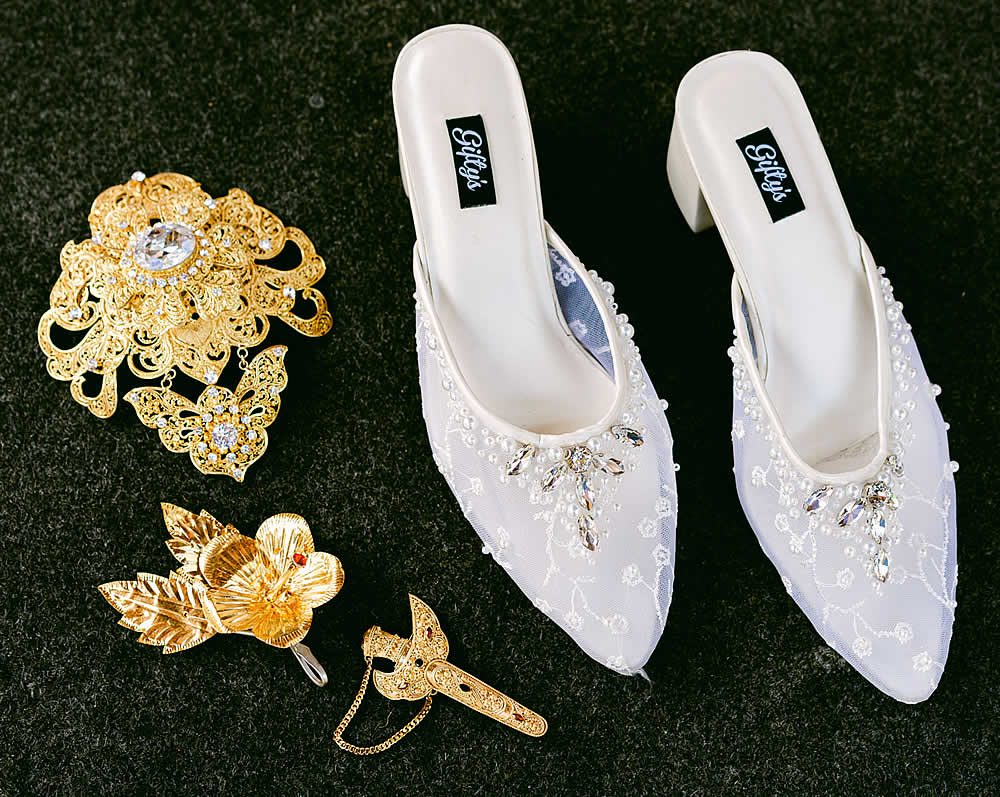
Beautiful white bridal shoes adorned with gold jewel accessories | Photo: Arjun Adinata
Digital and new media arts
BaliMotion — a collective of 103 digital and new media artists founded in 2024 — represents a new chapter. They project Tri Hita Karana through generative art and projection mapping on Bali’s architecture. They were selected for the J+ Art Awards at Nuanu’s inaugural Art & Bali fair in 2025. The island is developing a digital creative economy that builds directly on its cultural foundations rather than importing external aesthetics.
Ubud Open Studios — the annual creative open house
Now in its fifth edition, Ubud Open Studios 2026 invites over 60 local and international artists, designers, and creatives to open their studios to visitors in June. It is not a typical gallery hop. Studios are hidden in rice fields, village lanes, and compound gardens. Each visit offers direct access to the creative process — conversations with makers, watching techniques in action, buying directly from the source.
— HEALING ARTS & WELLNESS
The conscious traveler’s Bali — yoga, healing, and spiritual depth
Bali’s healing arts tradition predates the global wellness industry. Balian — traditional Balinese healers — have practised physical, spiritual, and emotional medicine for centuries, using plant medicines, sacred texts, and ritual as their tools. They still practise today, alongside retreat centres, yoga studios, and sound healing spaces that draw visitors from every continent.
The global yoga community found in Bali a place where spiritual practice is not imported or performative. It is indigenous. Balinese Hinduism, Tri Hita Karana, and the daily practice of ceremony create a context that gives yoga, meditation, and healing work a resonance that is hard to replicate elsewhere.
Yoga & teacher training
Ubud is a global hub for 200 and 500-hour yoga teacher training. Studios offer everything from Ashtanga to Yin to ceremonially-integrated practice.
Om & sound healing
The 396 Hz frequency, singing bowls, gamelan frequencies, and voice work as a healing modality — deeply rooted in Bali's sonic culture.
Om Swastiastu
Understanding Bali's sacred greeting is the first step toward understanding Balinese culture — and the healing intention woven into every interaction.
— CULTURAL CALENDAR
Festivals and cultural events
Bali’s cultural calendar is dense. Every month brings at least one major ceremony, festival, or arts event. The sacred and the secular interweave — a temple odalan (anniversary ceremony) is also a social gathering, a performance, and a feast. Here are the key events for conscious visitors and arts professionals.
Mar / Apr
Nyepi — Bali's Day of Silence
The Balinese New Year is celebrated with a full day of silence, fasting, and meditation. The entire island shuts down. No lights, no traffic, no noise. The night before, enormous ogoh-ogoh demon effigies parade through the streets and are burned. Nyepi is both the island’s most extraordinary cultural experience and a serious spiritual practice that even visitors must observe.
June
Bali Arts Festival (Pesta Kesenian Bali / PKB)
Held annually since 1979, PKB is Bali’s largest cultural celebration — a month-long festival of performing arts, visual art, and crafts at the Bali Arts Centre in Denpasar. Gamelan competitions, legong performances, woodcarving exhibitions, and batik workshops run in parallel. The 2026 theme is “Jana Kerthi Pramaguna Wikrama” — Uplifting Human Dignity and Excellence. Visitors can join workshops, attend competitions, and buy directly from artisans.
June
Ubud Open Studios
Now in its fifth edition (2026), 60+ artists open their studios across Ubud for a multi-day creative open house. The event gives direct access to Bali’s living contemporary art scene — from painters and sculptors to weavers and digital artists. The best introduction to what Bali’s creative community actually looks like beyond the gallery system.
Sep
Art & Bali — International Art Fair
Now in its fifth edition (2026), 60+ artists open their studios across Ubud for a multi-day creative open house. The event gives direct access to Bali’s living contemporary art scene — from painters and sculptors to weavers and digital artists. The best introduction to what Bali’s creative community actually looks like beyond the gallery system.
Oct
Ubud Writers & Readers Festival
Now in its fifth edition (2026), 60+ artists open their studios across Ubud for a multi-day creative open house. The event gives direct access to Bali’s living contemporary art scene — from painters and sculptors to weavers and digital artists. The best introduction to what Bali’s creative community actually looks like beyond the gallery system.
— LOOKING FORWARD
Bali’s creative future
“The question Bali faces is not whether its culture can survive globalisation. It is whether globalisation can keep up with Bali.”
Bali enters 2026 with its artistic identity more visible globally than at any point in its history. Art & Bali brings international collectors to the island. Ubud Open Studios exports Bali’s creative scene to the world. BaliMotion projects Tri Hita Karana onto the walls of the future. And ISI Denpasar keeps training world-class artists, composers, and performers who graduate into an increasingly connected global art market.
The challenges are real. Mass tourism can reduce culture to spectacle — performing arts become hotel shows, craft villages become souvenir factories, sacred ceremonies become photo opportunities. This pressure requires constant vigilance. It requires arts institutions, village communities, and conscious visitors to choose differently.
The opportunity is equally real. Bali’s creative economy — if nurtured well — can provide sustainable livelihoods independent of mass tourism. A woodcarver supplying a Paris design house, a silversmith creating pieces for a London jewellery brand, a digital artist exhibiting in Singapore: these are development outcomes as significant as any infrastructure project.
At Bali International, we will continue to document and support Bali’s creative ecosystem. We are developing multifunctional spaces on the island where global travelers, local artists, and development professionals can meet, collaborate, and produce together. Culture is not a soft add-on to development. In Bali, it is the foundation.
The gamelan keeps playing. The offerings keep appearing before dawn. The woodcarver’s chisel keeps moving. This island’s creative life is not fading — it is expanding, adapting, and reaching new audiences while remaining, at its core, devotional.
Culture and development — the bigger picture
RYB Global Development covers the international Culture of Peace framework, the post-2030 Culture SDG movement, and MONDIACULT 2025 in full depth. Culture is finally being recognised as a pillar of the global development agenda.
Culture of Peace —redyellowblue.org/culture-of-peace/
Culture of Peace —redyellowblue.org/culture-of-peace/