
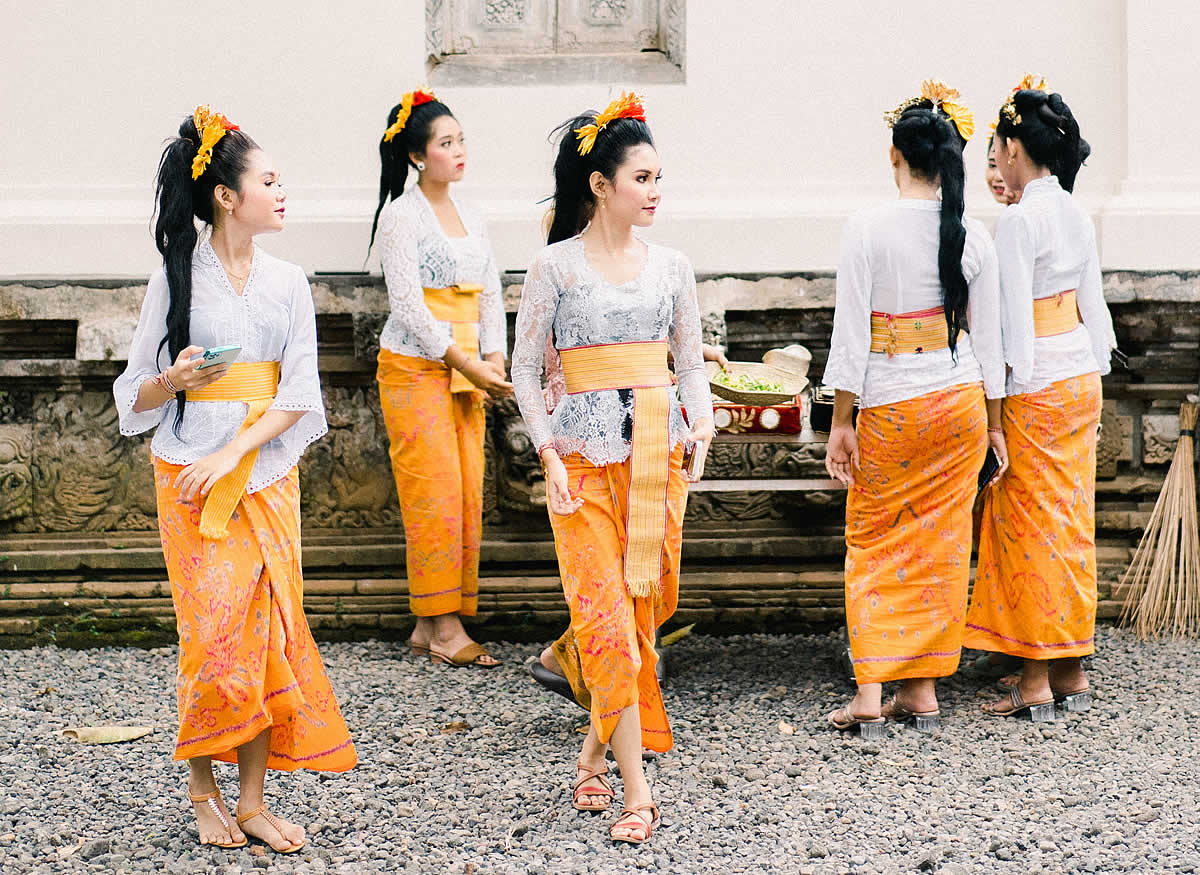
Women in Bali in traditional attire preparing for a cultural dance outdoors | photo Agung Pandit Wiguna
Bali International › Women
Women in Bali
Before most of the island is awake, Balinese women are already weaving the day’s first offerings. That single image holds most of what follows: devotion, skill, and a labor so constant it becomes invisible. This page looks at what’s underneath it.
Every morning, in doorways and shopfronts and at the foot of household shrines across the island, small woven trays of flowers and incense appear. Canang sari, they’re called, and in most homes it is women who make them, has been women for generations, palm leaf folded and pinned before the day’s other work begins. A single family compound sets out fifteen of these or more each day. Multiply that by every compound on the island, every single morning, and you start to see the scale of devotion Balinese women carry, quietly, without it ever being asked of them twice.
That’s one place to start understanding women in Bali. It is not the only one. This page moves through four: the ritual life women hold together, an art form they were once forbidden to touch, the economy they increasingly run, and a custom, older than any of it, that still decides whose name a family carries forward.
Women
Ritual Life — Devotion as Daily Practice
Canang sari means, roughly, essence offered in a small woven basket. Ca for beautiful, nang for purpose, sari for essence: even the word is built like a small act of care. Making one takes patience rather than speed, coconut palm leaf folded into a tray, flowers placed by color and direction, a pinch of betel nut and lime at the center standing in for Bali’s three major gods. Done well, it is close to meditation. Done at the pace most households need it, fifteen or more a day, it is also simply work, absorbed so completely into the rhythm of Balinese womanhood that it rarely gets counted as labor at all.
The gendering runs further than offerings alone. Walk past ceremonial preparations in most Balinese communities and the division is visible at a glance: women gathered together assembling offerings and preparing ceremonial food, men handling other ritual tasks entirely separately. Neither role is lesser in Balinese eyes. Both are understood as service, ngayah, to community and to god. But only one of them happens every single day, unpaid, before the rest of a woman’s work even begins.
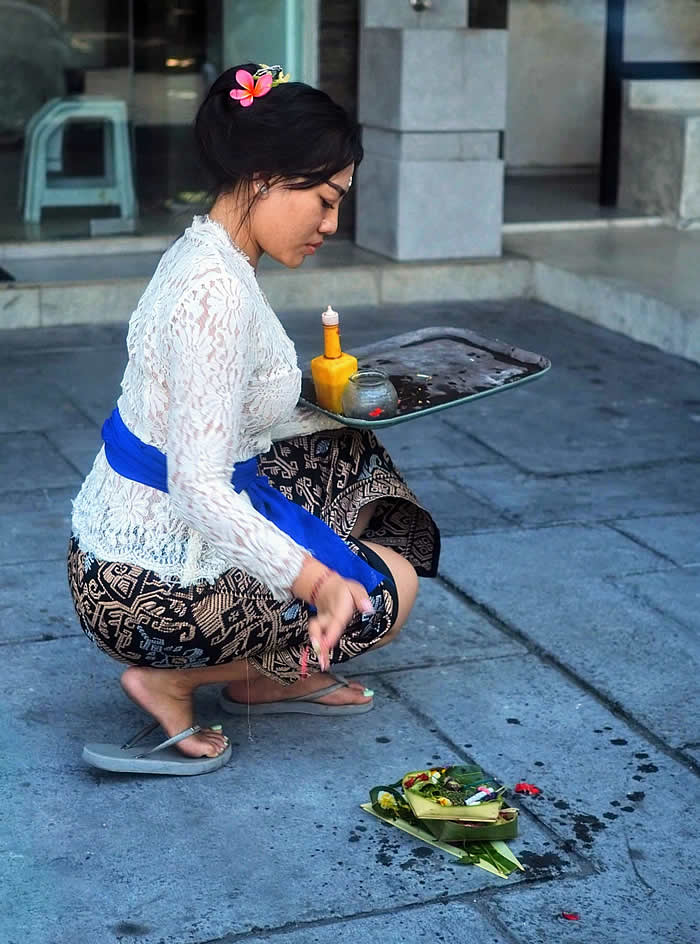
Canang sari is a daily Balinese Hindu offering made to thank the gods, maintain cosmic balance, and bring peace. It consists of a handwoven palm-leaf tray filled with colorful flowers, betel leaf, and burning incense | photo Ruyat Supriazi
Something worth noticing, though: this is changing, and not through anyone’s intervention. As more Balinese women take up formal jobs, fewer have the hours free each morning that canang sari making has always demanded. So a small industry has grown up around it, women who weave offerings by the hundred and sell them at market, other women who buy rather than make. A tradition of unpaid devotion has quietly become, for some, a livelihood. Nobody planned that. It just happened, the way most real change in Bali seems to.
Gamelan Wanita — An Art Form Women Weren’t Meant to Touch
For most of its history, Balinese gamelan belonged to men. Women danced to it, dressed for it, prayed around it. They did not play it. That held for centuries, until one wet night in 1985, in the village of Peliatan, when a group of women carried a full set of bronze gamelan instruments up a muddy, slippery path to a temple, on their shoulders, in the dark, because the instruments could not be allowed to touch the ground. At the top, Sekar Gong Wanita Mekar Sari gave Bali’s first public performance by an all-women gamelan ensemble.
It did not stay a one-off. Gamelan wanita, women’s gamelan, spread from that single Peliatan banjar to villages across the island within a decade. The Bali Arts Festival added a women’s gong kebyar competition the same year Mekar Sari first performed. Composers have since written pieces specifically for women’s ensembles, some later adopted back into the men’s repertoire, a small, quiet reversal of six hundred years of tradition. Today it isn’t unusual to find a village with both a men’s gamelan and a women’s one, playing the same music, learned the same way: by ear, by repetition, by muscle memory, the way every Balinese child has always learned it. The instruments never cared who held the mallets. It took people much longer to agree.
Women in Bali’s Economy
Tourism built modern Bali, and women built a great deal of tourism. Walk through any village or tourist town and the businesses run by women are everywhere, warungs serving home-style Balinese food, guesthouses, spas and wellness retreats, small workshops turning traditional textiles and crafts into a livelihood. Much of it is informal: family-run, seasonal, without the contracts or protections formal employment offers elsewhere. That informality cuts both ways. It’s given Balinese women a route into running their own businesses that a more rigid formal economy might not have offered. It has also left much of that work outside minimum-wage protection, outside social security, vulnerable whenever tourism itself has a bad year, as it periodically does.
The offering-vendor trade mentioned above is a small but telling example of the same pattern: an entire cottage industry, built by women, out of what was once simply expected of them for free.
Custom, Family, and a Name That Still Passes Through Sons
Underneath all of this sits something older and less visible to a visitor: Balinese customary law still does not, by default, treat daughters as heirs. Under adat, sons hold purusa status, they inherit the family’s land, carry its name forward, and take on its ancestral obligations, including care of the household temple. Daughters traditionally hold predana status, and predana does not inherit. A family with only daughters is still, in the phrase researchers hear repeated in villages today, spoken of as having no children at all, because in the terms that matter for lineage, a daughter cannot continue it.
Bali has built paths around this, genuinely and over real time. A daughter can be granted sentana rajeg status, standing in for a son when a family has none. In 2010, the island’s highest traditional-village authority formally recognized daughters’ right to a partial inheritance share. But researchers who study how this plays out village by village find the older principle still governs in practice more often than not, written into each village’s own customary bylaws, resistant to any single decree from Denpasar. It is, by every account, a living tension: Indonesia’s constitution guarantees equal rights on paper, while a still-thriving customary law, everywhere alive in Bali’s daily religious and social life, quietly keeps the old distinction intact underneath it.
This is one thread among several, alongside political representation, wages, and safety, that Gender Gap Bali follows in full, with current data on each.
Explore Further
- Gender Gap Bali — the data behind this page: pay, power, safety, and education on the island, checked against current statistics from BPS Bali, Indonesia’s Ministry of Women’s Empowerment and Child Protection, and local organizations including LBH APIK Bali.
- Culture Women’s Day Indonesia — the national story this page doesn’t retell: how and when Indonesian women won the right to vote, and how that history connects to the wider Women, Culture and Peace framework RYB Global Development is built around.
Sources and Links
- Canang Sari — Wikipedia | en.wikipedia.org
- Understanding Bali’s Daily Morning Offerings — G Adventures | gadventures.com
- Understanding Balinese Daily Offerings: Canang Sari — Merusaka Nusa Dua | merusaka.com
- Fire in the Banana’s Belly: Bali’s Female Performers Essay the Masculine Arts — Gale Academic OneFile / Asian Theatre Journal | go.gale.com
- Gamelan Wanita: A Study of Women’s Gamelan in Bali — Emiko Saraswati Susilo, University of Hawai’i at Mānoa | scholarspace.manoa.hawaii.edu
- Democracy and Equality in Balinese Gamelan, Part I — Mekar Bhuana Centre | balimusicanddance.com
- Reconstruct the Paradigm Shift of Inheritance Rights for Balinese Hindu Women — Russian Law Journal | russianlawjournal.org
- Inheritance in Balinese Customary Law: Dynamics and Its Linkage With Hindu Law — Jurnal Indonesia Sosial Teknologi (2024) | researchgate.net
- Gender Gap Bali — Bali International | bali.international/women/gender-gap/
- Culture Women’s Day Indonesia — RYB Global Development | redyellowblue.org/data/id/wdid/