
—— GLOBAL DEVELOPMENT • BALI, INDONESIA
Bali is not just a destination.
It is a development story.
An ancient island at the crossroads of global tourism, indigenous wisdom, and 21st-century sustainability challenges. Bali shows what development looks like up close — the contradictions, the breakthroughs, and the choices still ahead.
70.22
Indonesia SDG Index Score 2025
77th
Indonesia Global SDG Rank / 167
3.72%
Bali Poverty Rate · Lowest in Indonesia
2045
Kerthi Bali Long-Term Vision
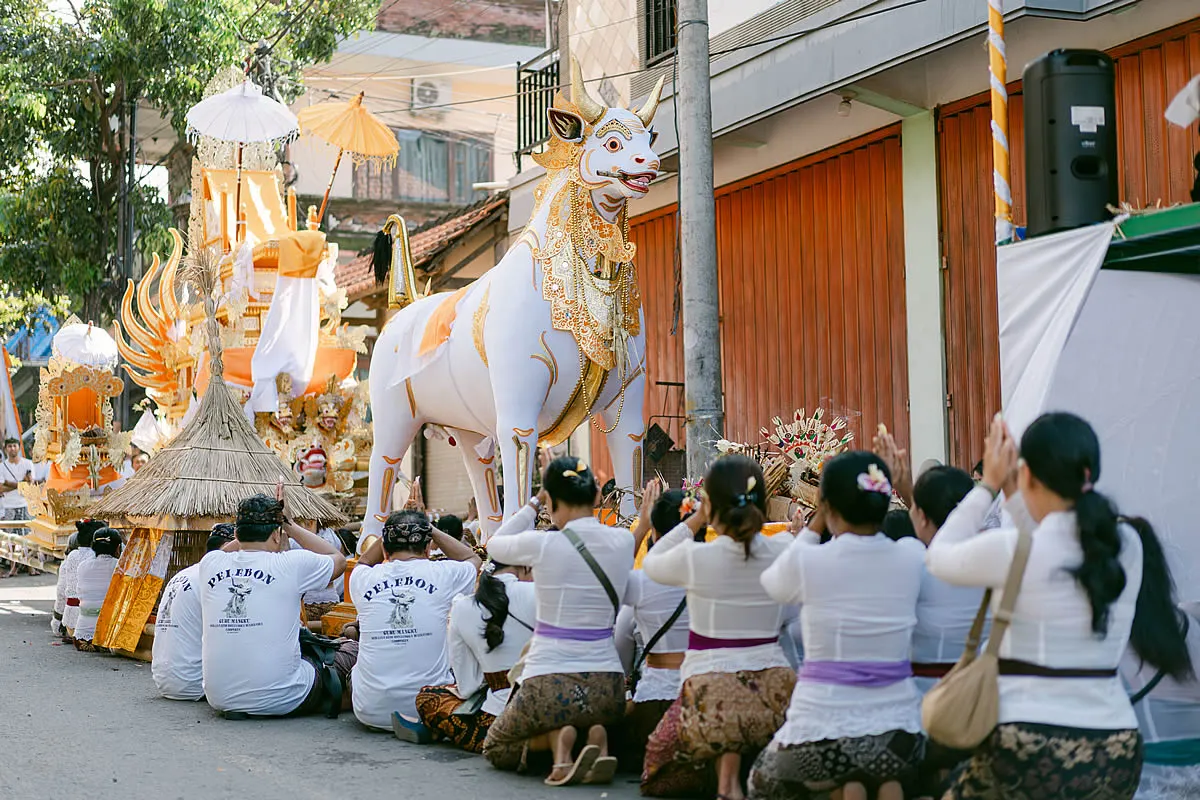
Balinese people participating in a vibrant traditional ceremony with intricate offerings and decorations | Photo: Arjun Adinata
— WHAT THIS PAGE IS ABOUT
Global development, seen from Bali
Global development is not an abstract idea. It is a rice farmer watching his water disappear. It is a young Balinese artist selling crafts to a Berlin gallery. It is a government choosing between a new hotel and a new water reservoir. On this page, we tell that story — from the island’s perspective.
This page focuses on Bali’s local and regional development context. We cover Indonesia’s national SDG progress, Bali’s own economic transformation strategies, and the organisations driving change on the ground. We do not repeat what is already covered elsewhere.
Want the global picture first?
Our parent platform RYB Global Development covers the full framework: what development means, the 17 SDGs, critical global issues, and how all 193 nations are building a better world.
Read: What Is Global Development? — redyellowblue.org/global-development
Read: What Is Global Development? — redyellowblue.org/global-development
Already read about Bali's tourism challenges?
Our Sustainable Tourism page covers the plastic crisis, water scarcity, the Bali tourism levy, and community-led environmental solutions in depth.
Read: Sustainable Tourism Development in Bali — bali.international/sustainable-tourism/
Read: Sustainable Tourism Development in Bali — bali.international/sustainable-tourism/
Indonesia country data and profile
Explore Indonesia's full data profile on RYB — population, economy, gender data, and development indicators across all regions.
Explore Indonesia at RYB — redyellowblue.org/data/id/
Explore Indonesia at RYB — redyellowblue.org/data/id/
Table of Contents
— THE LOCAL CONTEXT
What does development mean here?
Bali is one of Indonesia’s 38 provinces. Yet it carries a global reputation entirely out of proportion to its size. The island covers just 5,780 km² and is home to 4.3 million people. Still, it receives over 16 million visitors annually.
That weight changes everything. Development in Bali is not primarily about access to basic services. Bali already has the lowest poverty rate in Indonesia at 3.72% (March 2025). Development here means something more subtle: how does a small, culturally extraordinary island stay itself while integrating into the global economy? How does prosperity translate into wellbeing — not just for tourists, but for the Balinese?
“Bali’s economic transformation is inseparable from national economic transformation — but it must be rooted in the island’s own culture and identity.”
Rachmat Pambudy, Minister of National Development Planning, Indonesia — October 2025
Development in Bali also carries a philosophical grounding that most development frameworks lack. The Balinese worldview of Tri Hita Karana — balance between people, nature, and the divine — is not a metaphor. It is encoded in law, embedded in village governance, and practiced daily through ceremony, agriculture, and community life.
This philosophy predates the SDGs by centuries. Yet it maps onto them with striking precision. Tri Hita Karana is Bali’s indigenous version of integrated sustainable development — and it is increasingly studied as a global model.
— LOCAL WISDOM • GLOBAL RELEVANCE
Tri Hita Karana: Bali’s original development framework
Long before Environmental, Social, and Governance (ESG) became a corporate buzzword, Bali had Tri Hita Karana. This Balinese Hindu philosophy translates as “three causes of happiness.” It holds that true prosperity requires harmony across three relationships:
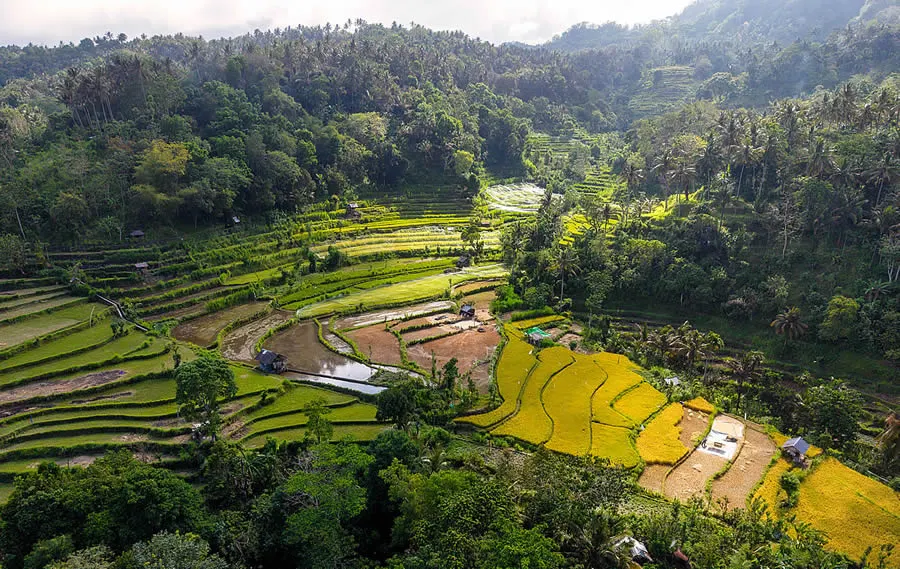
Parahyangan — Harmony with the divine
Every village, rice field, and business in Bali maintains a temple. Daily offerings, seasonal ceremonies, and ritual calendars are not optional extras. They are the infrastructure of community cohesion. This spiritual dimension is what makes Balinese culture so distinctive — and so resilient.
Pawongan — Harmony among people
The banjar system — neighbourhood associations of roughly 50–100 households — governs everything from waste management to weddings. Participation is compulsory and moral. The values of gotong royong (mutual assistance) and rukun (harmony) shape how development decisions are made and who benefits.
Research published in 2025 describes Tri Hita Karana as a “globally relevant framework for integrated community development.” Businesses that integrate its three pillars gain local legitimacy and a competitive edge in an ESG-driven global market.
— GOVERNMENT STRATEGY
The Kerthi Bali Economic Transformation Roadmap
In December 2021, Indonesia’s President launched the New Era Bali Kerthi Economic Roadmap. The strategy was developed jointly by the Ministry of National Development Planning (Bappenas) and the Bali Provincial Government. It reflects a recognition that Bali’s over-reliance on tourism is a structural vulnerability — not a strength.
The roadmap directly references Tri Hita Karana as its philosophical foundation. It sets a course toward a green, resilient, and prosperous Bali by 2045. Its ambitions are striking: workforce productivity to increase fourfold, poverty to fall to 0.18%, and per capita GRDP to grow eightfold.
Organic Agriculture
Reviving indigenous farming, protecting rice paddies, and creating new income streams through high-quality organic products.
Maritime & Fisheries
Bali's coastal communities develop sustainable blue economy models — marine conservation linked to local livelihoods.
Culture-Based Industries
Performing arts, ceremonial crafts, and cultural tourism as formal economic sectors — not informal by-products.
Creative & Digital Economy
New co-working spaces, digital startups, and an emerging tech community build Bali's knowledge economy from within.
Crafts & MSMEs
Micro, small, and medium enterprises rooted in Balinese craft traditions — silversmithing, woodcarving, batik, and textiles.
Quality & Green Tourism
Moving from mass volume to high-value, low-impact tourism. The Sanur Special Economic Zone for medical tourism leads the way.
In October 2025, the TKB Secretariat was reactivated at the Bali Development Planning Agency (Bappeda). This delivery unit links national government, the Bali provincial government, and development partners. Minister Pambudy described Bali as a potential “model for regional economic development rooted in local potential” — a prototype for the rest of Indonesia.
Two Special Economic Zones (SEZs) are already operational: the Sanur SEZ (medical and wellness tourism) and the Kura Kura SEZ (creative economy and tourism). Both are anchors of the diversification strategy.
— INDONESIA & THE SDGs
Indonesia’s SDG performance in 2025
The Sustainable Development Report 2025 ranks Indonesia 77th out of 167 countries, with an SDG Index Score of 70.22 out of 100. Indonesia is part of the G20 and one of the world’s largest emerging economies. Its SDG trajectory matters for Bali — and for the region.
70.22
SDG Index Score • Out of 100
77 / 167
Global SDG Rank • 2025
95.22
Spillover Score • Low negative impact on others
The Indonesian government publishes annual SDG indicator data through BPS Statistics and the SDGs National Secretariat of Bappenas. The 2025 edition integrates statistical data, SDG achievement analysis, and spatial mapping for the first time — a significant step toward evidence-based governance.
| SDG | Topic | Indonesia Status |
|---|---|---|
| SDG 1 | No Poverty | IMPROVING – National poverty rate declining; Bali lowest at 3.72% |
| SDG 2 | Zero Hunger | CHALLENGES – Child stunting fell from 26.4% (2012) to 23.2% (2024) |
| SDG 6 | Clean Water | MAJOR CHALLENGE – Bali’s water table sinking; 65% of fresh water used by tourism |
| SDG 8 | Decent Work | CHALLENGES – Tourism-driven; economic diversification strategy underway |
| SDG 11 | Sustainable Cities | CHALLENGES – Waste management, traffic, and infrastructure under pressure |
| SDG 14 | Life Below Water | MAJOR CHALLENGE – Indonesia is world’s 2nd largest ocean plastic polluter |
| SDG 15 | Life on Land | CHALLENGES – 10 km² of rice fields lost to development annually since 1980s |
| SDG 16 | Peace & Institutions | STRENGTHENING – Village Fund (USD 5B/yr) improves local governance and SDG delivery |
| SDG 17 | Partnerships | ACTIVE – G20 Bali Leadership, Global Blended Finance Alliance, bilateral partnerships |
Globally, only 35% of SDG targets are on track as of 2025. The UN Secretary-General has called it “a development emergency.” Indonesia’s score of 70.22 places it in the upper-middle tier — real progress, but with significant gaps remaining, especially on water, ocean health, and gender equality.
— SDG 5 • GENDER EQUALITY
Women, development, and Bali
Women are central to Bali’s economy and its cultural continuity. They run market stalls, weave offerings, manage family compounds, and increasingly lead tourism businesses. Yet gender data gaps persist across Indonesia — women’s economic contributions remain undercounted in national statistics.
Indonesian women gained the right to vote in 1945, at independence. But political representation and economic parity remain ongoing challenges at the national level. Indonesia ranks 87th on the Global Gender Gap Index.
Women's rights and gender data in Indonesia — read the full analysis at RYB
We cover women's voting rights history, gender gap data, and the Women, Culture and Peace framework in depth on our main platform.
Women, Culture and Peace — redyellowblue.org/women-culture-and-peace
Gender Data — redyellowblue.org/organizations/gender-data
Women, Culture and Peace — redyellowblue.org/women-culture-and-peace
Gender Data — redyellowblue.org/organizations/gender-data
— CIVIL SOCIETY AND CREATIVE INDUSTRIES
Who is doing the work in Bali?
NGOs, community organisations, and creative enterprises are often ahead of government policy. In Bali, several organisations are directly advancing the SDGs — even when they do not use that language.
Sungai Watch
River barrier network intercepting plastic before it reaches the ocean. Over 1 million kg collected by 2024. Founded by Gary and Sam Bencheghib; now operating 180+ barriers across Bali and beyond.
Bye Bye Plastic Bags
Youth-led movement founded by Melati and Isabel Wijsen. Their work achieved Bali’s official plastic bag ban in 2019. They have since reached over 1 million young people globally through education campaigns.
BaliMotion
Founded in 2024, this collective of 103 digital and new media artists reinterprets Tri Hita Karana through projection mapping and generative art. They represent Bali’s emerging creative economy at its most inventive.
Organic Farming Movement
A growing network of Balinese farmers and cooperatives reviving indigenous agriculture. Organic rice, herbs, and specialty foods build income streams independent of tourism while preserving the island’s sacred landscape.
IDEP Foundation
Pioneering permaculture and community resilience in Bali since 1999. IDEP trains villages in water management, food security, and disaster preparedness — combining traditional knowledge with practical solutions.
Youthtopia (Melati Wijsen)
Free peer-to-peer learning platform for young changemakers globally. Founded in 2020 by Melati Wijsen after the success of Bye Bye Plastic Bags — a model of how Balinese youth can generate global impact.
How do Balinese organisations contribute to the SDGs? Often without naming them. A woodcarver supplying a Paris design house creates decent work (SDG 8), supports cultural heritage (SDG 11), and strengthens global partnerships (SDG 17). The global goals and local practices are not separate worlds — they map onto each other when you look closely enough.
Find Bali's conscious businesses in our directory
Eco resorts, social enterprises, yoga studios, and cultural organisations across the island — verified and listed by Bali International.
Browse the Bali International Directory — bali.international/directory
Browse the Bali International Directory — bali.international/directory
— ARTS • CULTURE • HEALING
Culture as a development strategy
At RYB, we believe culture is not a soft add-on to development. It is the foundation. Bali makes this case better than almost anywhere on earth.
The island’s traditional performing arts — Gamelan music, Kecak dance, shadow puppetry — are not heritage displays. They are living practices embedded in community governance, seasonal farming calendars, and the ritual care of temples and rice fields. They are, in the language of the UN, “cultural expressions contributing to sustainable development.”
The global yoga, wellness, and healing arts community has found in Bali a place where spiritual practice is not imported but indigenous. Ubud’s retreat industry generates significant revenue. More importantly, it creates a new kind of global traveler — one who comes not to consume, but to learn. This is the intersection where Bali International is positioned.
At the global level, 150+ nations backed a dedicated Culture SDG at MONDIACULT 2025. Culture is finally being recognised as a pillar of development — not just an instrument of it. Bali has known this for centuries.
— LOOKING FORWARD
Bali’s development future
“The question is not whether Bali can afford sustainability. The question is whether Bali can afford to continue without it.”
Bali enters the final stretch of the SDG decade with real momentum. The Kerthi Bali roadmap is active. The Sanur and Kura Kura Special Economic Zones are operational. A new coastal protection law is in force. The tourism levy is generating conservation funding. And the island’s young activists are building global movements from their villages.
The challenges are equally real. Water scarcity is worsening. Plastic pollution requires systemic solutions, not just beach cleanups. Economic dependence on tourism — over 80% of GDP — remains a structural fragility. Gender data gaps persist. And the 2030 deadline is close.
What happens in Bali matters beyond Bali. The island is a prototype. If a small, globally exposed, culturally rich island can build a development model that honours its own philosophy while meeting 21st-century standards — that is a model the world needs.
At Bali International, we will continue to document this story. We are developing multifunctional meeting spaces in Bali — for global travelers, local creatives, and development professionals to meet, exchange, and create together. Watch this space.
The next chapter of Bali’s story is being written now. We invite you to be part of it.