
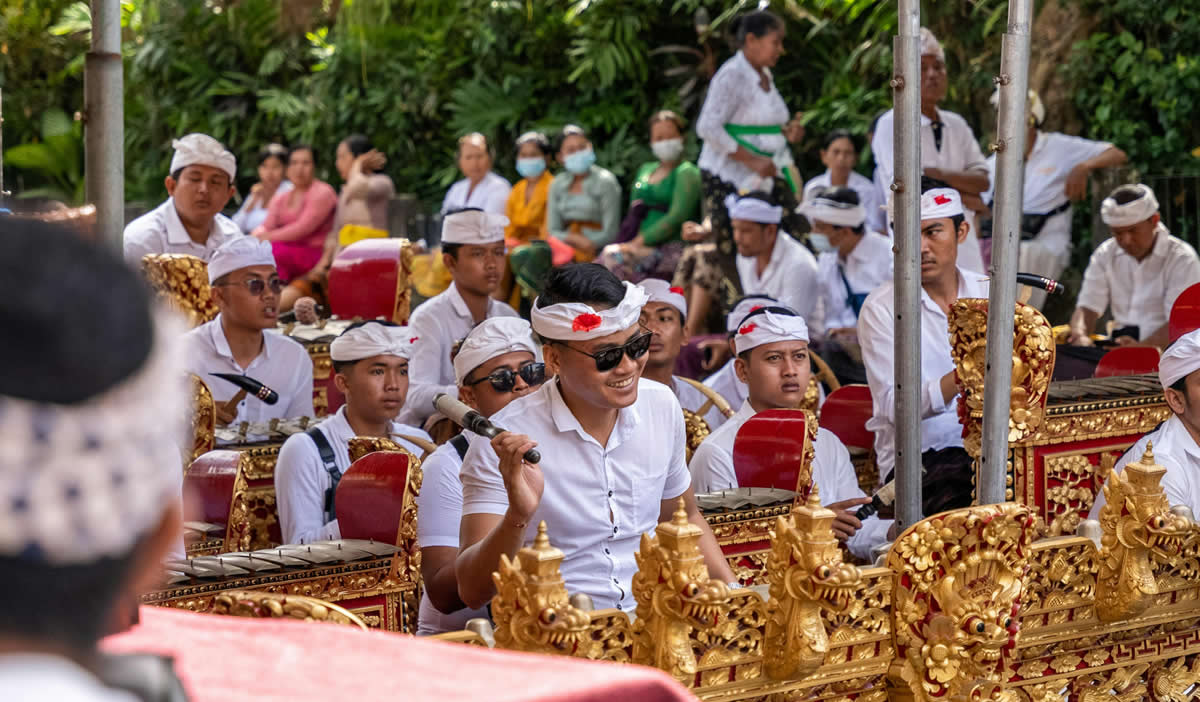
Traditional Balinese Gamelan Musicians Performing Outdoors. Photo by Pragyan Bezbaruah
Gamelan Bali (Balinese Gamelan) – Traditional Music of Bali
Arts & Culture
Gamelan Bali: The Shimmering Soul of an Island
Dawn breaks over Ubud. Before the roosters crow, you hear it. Bronze voices singing. Gongs breathing. Metallophones cascading like mountain waterfalls. The sound pours from a community pavilion where twenty musicians sit cross-legged. Their hands blur across bronze keys. This is gamelan. This is Bali’s heartbeat made audible.
Close your eyes anywhere on this island. You’ll hear it. From temple courtyards. From village squares. From palace grounds. From cremation ceremonies. Gamelan doesn’t just accompany Balinese life—it is Balinese life.
“Balinese Gamelan: Music, Dance, and Devotion” will feature BYU Professor Jeremy Grimshaw and visiting artists I Nyoman Windha and I Gusti Agung Ayu Warsiki. They will discuss the relationship between tradition and innovation in Balinese arts, including musical performances from members of Gamelan Bintang Wahyu, BYU’s Balinese percussion orchestra.
The Explosive Birth of Modern Kebyar
December 1915. Jagaraga village, North Bali. A gamelan competition that changed everything.
When Gong Kebyar exploded onto the scene, witnesses reported that people became dumbfounded. Tied cattle in fields and cages slipped their bonds and ran away. The sound was that shocking. That revolutionary. That powerful.
Gamelan gong kebyar originated in northern Bali around 1914, characterized by rapid tempos, intricate interlocking rhythmic patterns, sudden dynamic shifts, and close integration with dance. The name itself tells the story. “Kebyar” means explosive. Quick. Sudden. Loud.
This wasn’t your ancestors’ gamelan. This was rebellion cast in bronze.
Some view gong kebyar as counter-culture—a response to Dutch colonial oppression in North Bali. When you can’t fight with weapons, you fight with art. You fight with sound. You fight with innovation so brilliant it can’t be ignored.
And ignored it wasn’t. Within decades, over 1,500 active gamelan orchestras spread across Bali, with gong kebyar becoming the most prevalent form.
Ancient Voices, Ancient Forms
But gamelan existed long before kebyar’s explosive arrival. Much longer.
Wander into certain villages today. You might hear gamelan gender wayang. The smallest bronze gamelan, requiring only two players, gender wayang is essential for wayang shadow puppet theatre and most sacred Balinese Hindu rituals.
Or you might encounter gamelan semar pegulingan. Dating back to around the 17th century, semar pegulingan is sweeter and more reserved than kebyar. The name reveals its purpose. “Semar” is the Hindu god of love. “Pegulingan” means laying down. This ensemble was originally played near palace sleeping chambers to lull the king and his concubines to sleep.
Imagine that. Music so refined, so elegant, that royalty drifted to sleep on its waves.
Then there’s gamelan gambuh. The grandmother of all Balinese gamelan. Gamelan gambuh uses bamboo flutes and features a seven-tone scale, exuding an aura of ancientness. Listen carefully to any gamelan today. You’ll hear gambuh’s DNA echoing through the centuries.
Bali’s gamelan forms divide into three historical groups. Gamelan tua—the old ensembles like selonding and gender wayang. Gamelan madya—middle-period forms including semar pegulingan and pelegongan. Gamelan anyar—modern creations like gong kebyar that emerged in the 20th century.
Each serves different purposes. Different ceremonies. Different spiritual needs.
The Sacred Technology of Bronze
Twenty-five musicians. Sometimes more. Each with a specific role.
The bronze instruments shine under morning sun. Gangsa metallophones form the melodic core. Their keys suspended over bamboo resonators create that characteristic shimmer. Kebyar instruments range five octaves, from deepest gongs to highest gangsa keys. The high end pierces like sunlight on water. The low end booms like thunder in mountains.
Drums lead everything. The kendang players are conductors, spiritual guides, timekeeper all at once. They face the dancers. They watch every gesture. They breathe with every movement.
Then come the gongs. Large hanging gongs mark time’s great cycles. Smaller gong-chimes—the trompong and reong—weave melodies. Bronze cymbals called ceng-ceng drive rhythms forward with insistent urgency.
And the tuning? No standard pitch exists in Balinese music. Each gamelan ensemble tunes to itself. You cannot swap instruments between groups. Each orchestra is unique. Each has its own voice. Its own personality.
This matters spiritually. When musicians commission a new gamelan, they do it together. The instruments are born together. Tuned together. They belong to their community.
The Interlocking Magic of Kotekan
Here’s where it gets mystical. And mathematical. And deeply human all at once.
Balinese gamelan uses a technique called kotekan. Two musicians play interlocking parts. One plays “polos”—the basic pattern. Another plays “sangsih”—the interlocking countermelody. When combined, they create a single rapid melodic filigree, like birds bobbing their beaks while pecking grain.
Neither part makes complete sense alone. Together? Pure magic. Liquid bronze. Waterfalls of sound.
This isn’t just musical technique. It’s philosophy. It’s the Balinese principle of balance made audible. Male and female instruments paired. High and low voices dancing. Individual parts incomplete without their partner.
No improvisation happens. Musicians learn through traditional aural methods with incredible dedication over long rehearsal periods. No sheet music. No notation. Everything by ear. By memory. By feeling.
This communal learning embodies sekaha—voluntary collectives formed for common purpose. The sekaha gong, or gamelan club, represents the highest expression of Balinese community cooperation.
The Revolutionary: I Wayan Lotring
Some artists define eras. I Wayan Lotring (1887-1983) defined a century.
Lotring is considered one of the seminal creative forces of 20th-century Balinese gamelan, helping shape the development of pelegongan, kebyar, gender wayang, and angklung. He didn’t just play music. He transformed it. He pushed boundaries. He imagined new possibilities.
His compositions bridged ancient and modern. They referenced older forms like gambuh while celebrating newfound freedom. They were traditional and revolutionary simultaneously.
Lotring trained in Sukawati, the heart of legong dance and music training from 1850 to 1920. He studied with masters. He absorbed everything. Then he innovated.
His influence ripples through every modern gamelan piece. Every contemporary composer stands on foundations he built.
Wayan Lotring (1973 Kuta village, Bali)
The Westerner Who Fell Under the Spell
A young Canadian composer named Colin McPhee heard Balinese gamelan recordings. His life changed instantly.
McPhee moved to Bali in the 1930s and produced the most ambitious work on gamelan of his era: “Music in Bali.” He didn’t just study. He lived it. He built a house near Sayan. He surrounded himself with musicians. He learned to play. He transcribed compositions. He became part of the tradition.
His book remains foundational. His transcriptions preserved music that might have vanished. His passion introduced gamelan to Western audiences who’d never imagined such complexity existed outside European classical music.
McPhee also composed. He wrote “Tabuh-Tabuhan” for Western orchestra—a piece inspired by Balinese gamelan structures. It built bridges between worlds.
Modern Masters: Keeping Tradition Alive
I Nyoman Windha. I Dewa Putu Berata. I Made Subandi. I Ketut Cater. These names matter.
Master musicians like I Nyoman Windha, I Dewa Putu Berata, I Made Subandi, and others have taught extensively both in Bali and internationally. They’ve trained generations of students. They’ve composed hundreds of pieces. They’ve maintained standards while encouraging innovation.
I Dewa Putu Berata founded Çudamani—one of Bali’s most innovative gamelan ensembles. Çudamani has become an important artistic center in Bali, studying and preserving rare classic forms while nurturing young artists’ creative energies. The group tours internationally. They’ve performed at Lincoln Center. They’ve won countless competitions.
Berata’s vision extended beyond performance. Çudamani created groundbreaking programs. Including girls’ gamelan training—revolutionary in a traditionally male-dominated field.
I Made Subandi (1966-2023) pushed experimentation. In 1999, Subandi composed a soundtrack for the 1933 silent film “Legong: Dance of the Virgins” with American composer Richard Marriott, scored for Balinese gamelan, string quartet, trumpet, and clarinet. He collaborated with Dutch and American ensembles. He broke rules. He asked “what if?”
These masters understand something crucial. Tradition isn’t static. It’s living. Breathing. Growing. They honor the past by refusing to let it fossilize.
The Radical Innovator: Dewa Ketut Alit
Then there’s Dewa Ketut Alit. Born 1973. The composer who said “what if we start from zero?”
In 2007, Dewa Alit founded Gamelan Salukat, performing on a new set of instruments of his own tuning and design. He didn’t just compose for existing gamelan. He invented an entirely new one.
The word “Salukat” combines “salu” (house) and “kat” (regeneration and cycles of rebirth)—a place for new creativities based on tradition.
Alit’s gamelan uses a 10-note scale. Not five. Not seven. Ten. Alit presents gamelan not as something static from the past, but as concepts and principles that can create something radically new.
His composition “Geregel” (2000) influenced musicians worldwide. It received scholarly analysis in academic journals. His “Genetic” (2020) strips gamelan to its core elements—its musical DNA—then recombines them in unexpected ways.
Gamelan Salukat has toured extensively throughout Asia, Europe, and North America, presenting Alit’s contemporary Indonesian music. They’ve collaborated with Bang on a Can All-Stars. They’ve performed at festivals from Bali to Berlin.
Alit teaches internationally. MIT. University of British Columbia. Singapore. Everywhere he goes, he plants seeds. He shows that tradition and innovation aren’t opposites. They’re partners.
Siklus by Dewa Alit, performed at Bourse de Commerce, Paris, 2022
Institut Seni Indonesia: The Academy
The Indonesian government established ASTI Denpasar—now Institut Seni Indonesia (ISI) Denpasar.
ISI Denpasar is Indonesia’s premiere higher education institution for Balinese traditional performing arts. Here, students receive formal training in gamelan composition, performance, and theory. They study with master teachers. They learn both traditional repertoire and contemporary techniques.
The institute serves multiple roles. It preserves endangered gamelan forms. It documents vanishing traditions. It trains the next generation. It conducts research. It hosts festivals and competitions.
Every major Balinese composer of the last fifty years studied here. The institution balances respect for tradition with encouragement of innovation. Students learn ancient semar pegulingan pieces. They also compose experimental new works.
ISI Denpasar’s professional ensemble tours internationally. They represent Bali’s living gamelan tradition to the world. They show that this music isn’t museum artifact. It’s contemporary art form.
Gamelan Sekar Jaya: Bali in Berkeley
Berkeley, California. A group of Americans fell in love with Balinese gamelan.
Gamelan Sekar Jaya, comprised of four kinds of gamelan—angklung, gong kebyar, jegog, and gender wayang—has presented over five hundred concerts in the United States, Canada, and Mexico.
The group’s name means “Glorious Flower.” It’s apt. For four decades, they’ve blossomed as one of the finest Balinese gamelan ensembles outside Indonesia.
What makes Sekar Jaya special? Authenticity. Musicians learn through direct imitation and training from teachers, without notation—true to Balinese tradition. They host master teachers from Bali annually. They commission new compositions. They tour. They teach workshops in schools and community centers.
The group has welcomed legendary musicians. I Ketut Cater, music director of Semara Ratih in Bali, regularly teaches with them. Cater composes and serves as master teacher for groups competing in Bali’s annual Gong Kebyar Festival, where his compositions have won first prize.
Sekar Jaya proves something important. Gamelan can thrive anywhere. When approached with respect, dedication, and love—when teachers share generously and students commit fully—the tradition transplants successfully.Lorem ipsum dolor sit amet, consectetur adipiscing elit. Ut elit tellus, luctus nec ullamcorper mattis, pulvinar dapibus leo.
Mekar Bhuana: Saving the Endangered
Some gamelan forms were dying. Ancient instruments gathering dust. Rare tunings forgotten. Classical repertoires disappearing.
Then came Vaughan Hatch and Putu Evie Suyadnyani. In 2000, Hatch purchased and restored a disused antique Semara Pagulingan gamelan, founding Mekar Bhuana to document, reconstruct, and repatriate endangered classical gamelan and its extensive repertoire.
Mekar Bhuana became a rescue operation. A preservation project. A living archive. They’ve restored multiple gamelan sets—some dating to the 1800s. They’ve researched forgotten tunings. They’ve reconstructed lost pieces. They’ve trained musicians in rarely-played forms.
The organization owns multiple rare ensembles including seven-tone Semara Pagulingan, Selonding sets modeled on ancient formations, and old-fashioned Angklung from the 1800s.
They don’t just preserve instruments as museum pieces. They play them. At ceremonies. At concerts. At weddings. The gamelan live. They serve their communities. Tradition breathes again.
Contemporary Experiments and Hybrid Forms
The 1990s saw a new movement emerge. Musik kontemporer—contemporary music that pushed boundaries further than ever.
Young composers with international teaching and touring experience now incorporate ideas from Western art and popular music, reaching across oceans. They blend gamelan with electronic processing. They combine Balinese and Western instruments. They explore new tunings, new scales, new possibilities.
Composer and gong-smith Wayan Beratha invented gamelan semara dana in 1986, combining gong kebyar orchestration with semar pegulingan’s seven-tone range. This “all-in-one” ensemble opened new compositional territories. Suddenly, composers could write pieces impossible on traditional gamelan.
The gamelan semaradana is quickly replacing gong kebyar as the most popular instrumental vehicle for new compositions in urban centers like Ubud and Denpasar.
Some worry this signals identity crisis. Others see natural evolution. The debate rages. Tradition versus innovation. Purity versus experimentation. Preservation versus progress.
But here’s the truth. Gamelan has always evolved. Kebyar itself was radical innovation in 1915. Semar pegulingan was once new. Every “traditional” form was contemporary once.
Gamelan and Global Culture
Today, gamelan has spread worldwide. Universities on five continents own gamelan sets. Ensembles thrive in Europe, Australia, Japan, across the United States.
Groups like Sekar Jaya in America and Sekar Jepun in Japan bring Balinese gamelan to international audiences. Students in Vancouver, London, Melbourne learn to play. YouTube videos share performances globally. Recordings reach millions.
Popular culture has embraced gamelan too. Film soundtracks feature its distinctive tones. Anime series use gamelan and kecak. Video games sample its rhythms. Electronic producers incorporate its textures.
Yet gamelan remains quintessentially Balinese. Owing to non-Western scales, tunings, and inharmonic sound spectra, gamelan defies easy combination with Western equal-tempered instruments. You can’t just add gamelan to a rock band. The physics don’t work. The aesthetics clash.
This resistance to hybridization protects gamelan’s distinctiveness. Unlike Indian or African music that merged extensively with Western forms, gamelan stays Balinese. It maintains its identity. Its integrity.
The Sound of Collective Spirit
Here’s what strikes first-time visitors most. The ensemble nature of gamelan.
No stars. No soloists. No individual glory. Twenty-five people creating one sound. One voice. One spirit.
Yes, the kendang drummers lead. Yes, skilled trompong players shine. But the music only works when everyone contributes. When egos dissolve. When the collective becomes more than individuals.
This mirrors Balinese society itself. The banjar system where communities function as single unit. The subak irrigation cooperatives where farmers coordinate water use. The sekaha where villagers unite for common purpose.
Gamelan teaches cooperation. It teaches listening. It teaches that your part—however small—matters to the whole. Miss your strike, the entire piece suffers. Add extra flourish, you disrupt the pattern.
Play your role with precision and heart, and magic emerges. Not your magic. Collective magic. Community magic.
Women Enter the Bronze World
For centuries, gamelan was male domain. Women danced. Men played. Clear division. Strict tradition.
Then things began changing. Slowly at first. Revolutionary figures started welcoming women musicians. Groundbreaking ensembles like Çudamani created girls’ gamelan programs. Female composers emerged. Gender barriers eroded.
Çudamani is known for welcoming women into the traditionally male-dominated field of gamelan musicianship. Today, all-female gamelan groups perform at major festivals. Women win competitions. Female composers gain recognition.
Ni Nyoman Srayamurtikanti represents this new generation. Srayamurtikanti studied with masters including her father, I Ketut Cater, and I Made Subandi, finishing her master’s degree in music composition in 2022. She now leads Sanggar S’mara Murti. She composes. She teaches. She tours internationally.
The transformation isn’t complete. Traditional contexts still favor male musicians. But the direction is clear. Women are claiming their place in gamelan’s future.
The Festival Culture
Bali pulses with gamelan competitions. Village versus village. Region versus region. The stakes? Pride. Prestige. Bragging rights.
The annual Bali Arts Festival, held since 1979, features prominent performances of gong kebyar ensembles, fostering community pride and attracting visitors. For weeks, different groups compete. Judges evaluate technique, expression, synchronization, energy.
These competitions drive innovation. Groups commission new pieces. Composers push boundaries to create competition-winning works. Standards rise. Skills sharpen.
But it’s more than competition. It’s community celebration. It’s cultural transmission. It’s pride in tradition. Villages prepare for months. Children learn alongside elders. Everyone participates.
Tourism has transformed these events. What were local competitions now attract international audiences. Cultural tours bring visitors to remote villages. Gamelan experiences appear in travel brochures.
Tourism initiatives like village-based gamelan experiences have integrated the music into cultural tours, enhancing economic sustainability while preserving traditional repertoires.
Some worry about commercialization. About performances becoming shows rather than rituals. About tradition diluted for tourist consumption.
Others argue tourism provides economic support. It values Balinese culture. It ensures gamelan remains viable livelihood. It spreads appreciation globally.
The tension remains unresolved. Perhaps it always will.
Teaching the Next Generation
Every afternoon in thousands of banjar, children gather. They learn gamelan. Not in schools. Not for grades. Because it’s what Balinese children do.
Teachers don’t use textbooks. They demonstrate. Children imitate. Repeat. Again. Again. Until muscles remember. Until rhythms become automatic. Until interlocking patterns feel natural.
This oral tradition stretches back centuries. Knowledge passes body to body. Ear to ear. Heart to heart. No notation required. No theory classes needed. Just presence. Attention. Dedication.
Single new pieces can take several months before completion, with groups writing music as they practice. The instructor leaves space for interpretation. The group improvises during rehearsal. Together, they shape the final form.
This isn’t passive learning. It’s active creation. It’s community composition. It’s tradition evolving in real time.
Modern pressures challenge this system. Formal education competes for children’s time. Digital entertainment beckons. Global culture intrudes. Western music gains popularity.
Yet gamelan persists. Parents still teach children. Schools still host ensembles. Villages still maintain their groups. The tradition adapts without disappearing.
Looking Forward
Stand at the crossroads. Look back. Look forward. What do you see?
Behind us: Centuries of tradition. Ancient forms preserved. Sacred functions maintained. Community bonds strengthened. Bali’s sonic identity secured.
Ahead: Uncertain territory. Climate change threatens. Mass tourism transforms. Globalization homogenizes. Development accelerates. Digital culture dominates.
Will gamelan survive? Will it thrive? Will it transform beyond recognition? Will it ossify into museum artifact?
The answer is yes. To all of it. Simultaneously.
Gamelan will survive because it serves needs deeper than entertainment. It maintains cosmic balance. It marks life transitions. It builds community. It connects humans with divine forces. These needs don’t disappear. They become more urgent as modern life fragments.
Gamelan will thrive because young composers keep innovating. Dewa Alit creates 10-tone scales. Srayamurtikanti blends tradition and experimentation. International collaborations spawn new hybrids. The music stays alive by refusing to stand still.
Gamelan will transform because it always has. Kebyar shocked 1915 audiences. Semar pegulingan evolved from gambuh. Gender wayang serves different functions than centuries ago. Evolution is the tradition.
Gamelan might ossify if communities stop playing. If children stop learning. If ceremonies become performances. If spirituality becomes spectacle. This is the real danger. Not change. But disconnection. Not innovation. But commercialization without heart.
The path forward requires balance. Preserving essential elements while allowing growth. Teaching traditional forms while encouraging contemporary creation. Honoring sacred functions while embracing artistic exploration. Maintaining Balinese identity while engaging global culture.
Organizations like ISI Denpasar, Mekar Bhuana, and Çudamani show the way. They preserve and innovate. They honor and transform. They root deeply while reaching widely.
International ensembles like Sekar Jaya prove gamelan can thrive beyond Bali. When approached with respect, when studied seriously, when loved deeply—tradition transplants successfully. Bali gains ambassadors. The world gains beauty.
Technology offers new possibilities. Digital archives preserve rare recordings. Online teaching reaches global students. Virtual gamelan introduces music to millions. Electronic processing creates new textures. These tools threaten nothing if used wisely.
What matters most? Keeping the spirit alive. The communal spirit. The spiritual purpose. The generosity of teaching. The discipline of learning. The joy of playing together.
As long as villages maintain their sekaha gong. As long as temples require gamelan for ceremonies. As long as children learn from elders. As long as communities gather to create bronze magic together. As long as cosmic balance needs maintaining through sound.
Gamelan will endure.
Listen. Right now, somewhere in Bali, twenty-five people sit cross-legged. Their hands hover over bronze keys. The kendang drummer raises his hand. The gong sounds. The cascade begins.
Shimmering. Explosive. Ancient. Modern. Sacred. Communal. Individual notes dissolving into collective glory.
This is gamelan. This is Bali. This is what happens when bronze becomes prayer. When rhythm becomes meditation. When music becomes the breathing of an entire culture.
The sound that shocked cattle in 1915 still startles first-time listeners today. The melodies that lulled kings to sleep still soothe troubled hearts. The rhythms that invoke gods still open portals to mystery.
Gamelan isn’t freezing. It’s not dying. It’s not becoming something else entirely. It’s doing what it’s always done—adapting while remaining itself. Growing while staying rooted. Reaching forward while honoring backward.
The future of gamelan is being hammered out daily. In village rehearsals. In university studios. In temple ceremonies. In international collaborations. In children’s first tentative strikes on bronze keys. In master composers’ bold experiments.
That future is bright. Bronze-bright. Temple-bell-bright. Sunlight-on-mountain-waterfall-bright.
Listen. Can you hear it? The cascade never stops. The gongs keep speaking. The rhythms keep dancing. The tradition keeps living.
This is gamelan. This is forever. This is now.
Om Swastiastu
Om Swastiastu: The Sacred Greeting That Opens Hearts in Bali